Trusted
PROVEN TRACK RECORD
Reliable
REGIONAL SUPPLIER
Specialised
GLOBAL EXPERTISE
Get in Touch

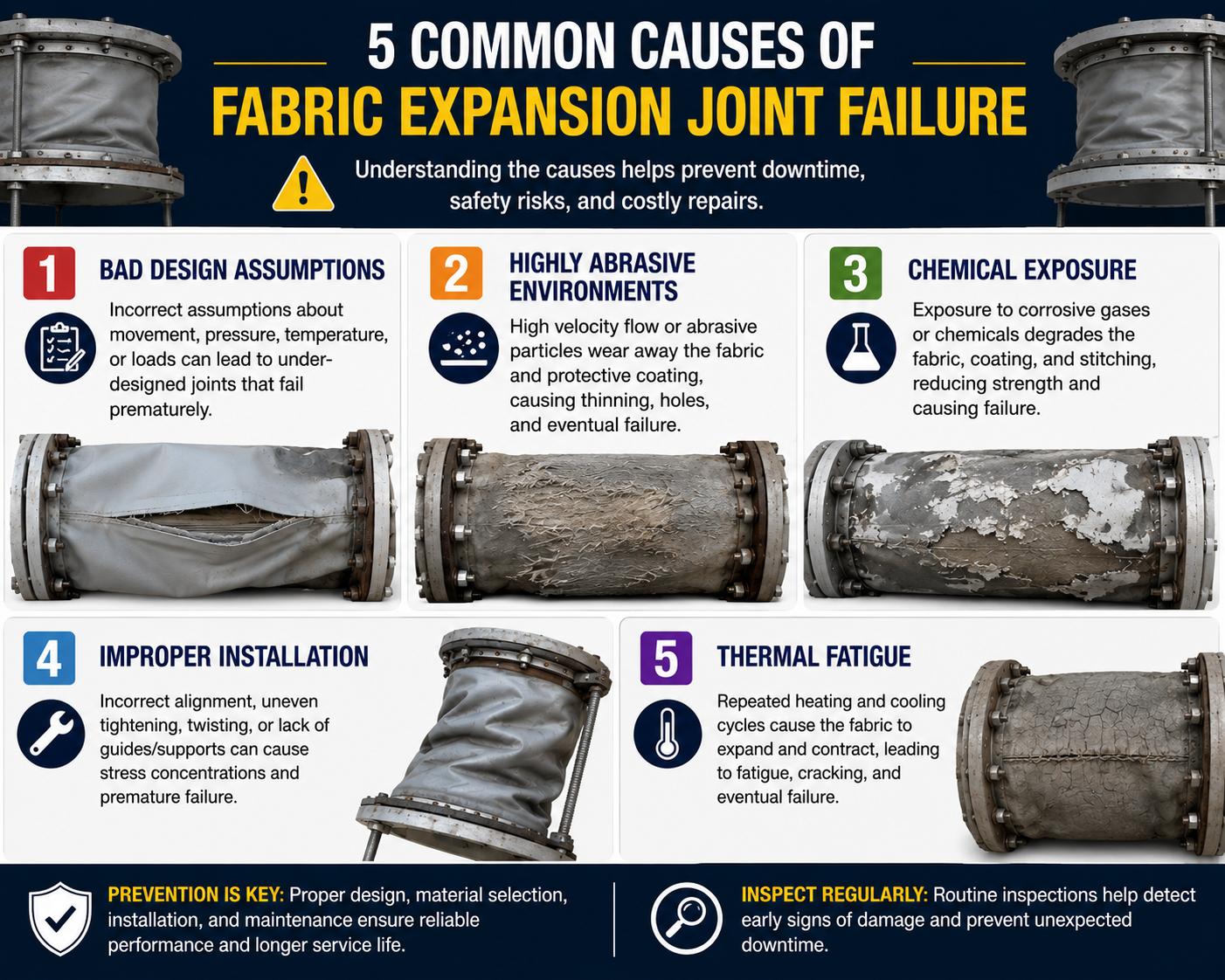
5 Common Causes of Fabric Expansion Joint Failure

 Causes of Fabric Expansion Joint – Fabric expansion joints do not just fail unexpectedly. In most cases failure happens because something was missed underestimated or ignored during design installation or operation.

Understanding the root causes is critical not only to prevent downtime but also to extend equipment life improve plant reliability and reduce maintenance costs.

In this article we break down the five most common causes of fabric expansion joint failure observed in real industrial environments.

5 Common Causes of Fabric Expansion Joint Failure:-

1. Bad Design Assumptions

One of the leading causes of expansion joint failure starts long before installation at the design stage.

Common design mistakes

  • Incorrect temperature or pressure assumptions
  • Underestimating movement ranges
  • Ignoring combined or dynamic movement

Why it matters

When movement or operating conditions exceed design limits the fabric joint experiences continuous overstressing leading to premature cracking delamination or rupture.

Result Early failure and unplanned shutdowns

2. Highly Abrasive Environments

Industrial systems handling dust ash or particulate matter present a high risk environment for fabric expansion joints.

Key risk factors

  • High velocity particles impacting the joint
  • Lack of internal liners or abrasion protection
  • Continuous exposure without shielding

What happens

Abrasive particles gradually wear down the fabric layers causing

  • Thinning of material
  • Surface erosion
  • Leakage or tearing

Result Reduced lifespan and increased maintenance frequency

3. Chemical Exposure

Fabric expansion joints are often exposed to corrosive gases vapors or chemical splash especially in industries like power generation cement and petrochemical.

Typical issues

  • Using incompatible fabric or coating materials
  • Exposure to acids alkalis or aggressive compounds
  • Lack of chemical resistance evaluation

Impact on performance

Chemical degradation breaks down the structural integrity of the joint material leading to

  • Loss of flexibility
  • Cracking and brittleness
  • Material breakdown

Result Sudden failure and potential safety risks

4. Improper Installation

Even a well designed expansion joint can fail if installed incorrectly.

Common installation errors

  • Misalignment between duct systems
  • Over extension or compression during installation
  • Uneven or loose clamping pressure

Why it is critical

Improper installation creates localized stress concentration which accelerates wear and leads to

  • Tearing at weak points
  • Joint deformation
  • Leakage at connection areas

Result Shortened service life despite good design

5. Thermal Fatigue

Fabric expansion joints in high temperature systems experience constant heating and cooling cycles.

What causes thermal fatigue

  • Frequent start stop operations
  • Large temperature fluctuations
  • Inadequate material selection for cyclic conditions

Long term effects

Repeated thermal cycling gradually weakens the internal layers of the fabric causing

  • Loss of elasticity
  • Layer separation
  • Structural fatigue

Result Progressive failure over time

Key Insight It Is Not Just About the Material

Most fabric expansion joint failures are not material problems.
They are engineering and application problems.

Choosing the right material is only one part of the solution. The real issue often lies in system design operating conditions and installation practices.

Klay Enersol Contact Information

Address:- 19-6 Block A, Jaya One, 72A, Jln Profesor Diraja Ungku Aziz, 46200 Petaling Jaya, Selangor DE, Malaysia.

Contact us:- +603 7960 0895

Mail ID:- sales@klayenersol.com

Causes of Fabric Expansion Joint Conclusion

If your fabric expansion joints are failing repeatedly replacing them with the same specification will not solve the problem.

It usually points to a deeper issue such as

  • Incorrect design assumptions
  • Unaddressed environmental factors
  • Installation inconsistencies

What you should do

  • Conduct a root cause analysis
  • Review system design parameters
  • Evaluate operating conditions and protection methods

Need Help Diagnosing Your Expansion Joint Issues

If you are facing recurring failures it is time to look beyond the joint itself.

Fixing the root cause can

  • Extend service life
  • Reduce maintenance costs
  • Improve system reliability

Reach out to evaluate your system and identify the best long term solution.

Related Tags:-