
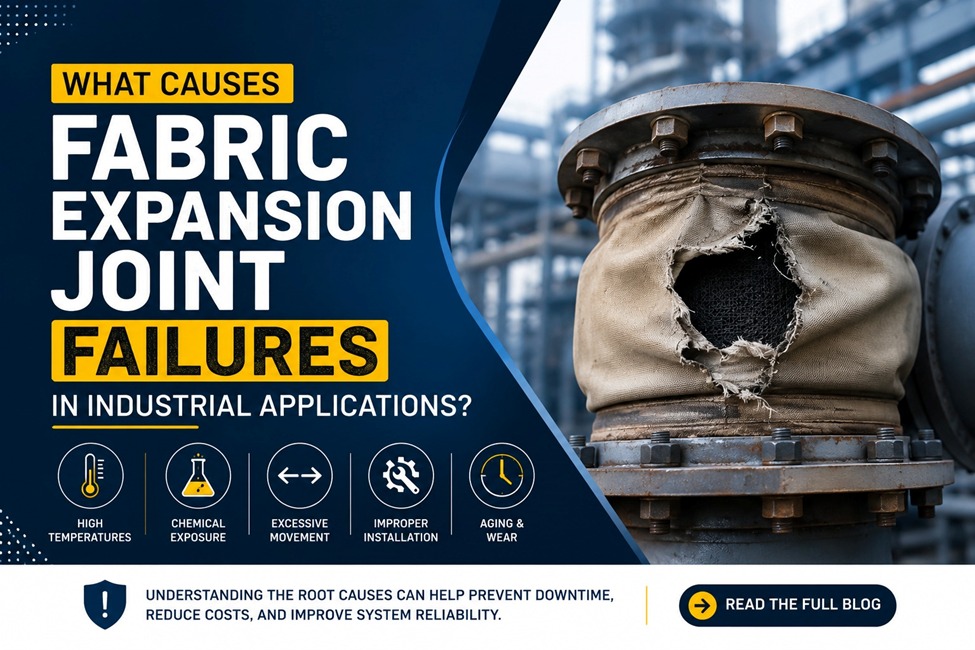
What Causes Fabric Expansion Joint Failures in Industrial Applications?
In many industrial facilities across Indonesia, Malaysia, and Singapore, Fabric Expansion Joints play a critical role in maintaining the integrity of ducting systems, exhaust lines, boilers, power plants, cement facilities, refineries, and process industries. These flexible components are designed to absorb thermal movement, vibration, and mechanical stress while ensuring efficient system operation.
However, when a Fabric Expansion Joint Failure occurs, what may initially seem like a minor issue can quickly escalate into significant operational challenges, including leakage, material degradation, system downtime, increased maintenance costs, and reduced reliability.
Understanding the root causes of these failures is essential for ensuring long-term performance and operational efficiency.
Understanding Fabric Expansion Joints
Fabric Expansion Joints are engineered flexible connectors designed to accommodate movement caused by thermal expansion, vibration, pressure fluctuations, and equipment misalignment.
Industries throughout Southeast Asia, particularly in Indonesia, Malaysia, and Singapore, rely on these expansion joints to maintain safe and efficient operations in demanding environments.
When properly designed and installed, these joints provide years of reliable service. However, several factors can contribute to premature failure.
1. Incorrect Design Specifications
One of the most common causes of Fabric Expansion Joint Failures is improper design.
Many failures occur because the expansion joint was not designed according to actual operating conditions. Critical factors such as:
- Temperature range
- Pressure conditions
- Gas composition
- Movement requirements
- Environmental exposure
must be accurately assessed during the engineering phase.
If the design does not account for real-world operating conditions, the expansion joint may experience excessive stress, resulting in early deterioration.
Impact:
- Premature wear
- Material fatigue
- Reduced service life
- Unexpected shutdowns
2. Excessive Thermal Movement
Industrial systems often experience substantial thermal expansion and contraction.
When thermal movement exceeds the designed capability of the Fabric Expansion Joint, the material may become overstressed, causing:
- Cracking
- Delamination
- Tearing
- Structural failure
This issue is particularly common in power generation plants, refineries, and high-temperature processing facilities throughout Malaysia, Singapore, and Indonesia.
Prevention:
Accurate movement calculations and proper expansion joint sizing are essential.
3. Abrasive Operating Conditions
Many industrial processes involve dust, ash, particulate matter, and abrasive gases.
Over time, these particles can continuously impact the expansion joint surface, gradually wearing away protective layers.
Industries at risk include:
- Cement plants
- Steel manufacturing
- Mining operations
- Biomass facilities
- Power plants
Consequences:
- Surface erosion
- Fabric thinning
- Leakage development
- Accelerated failure
Using abrasion-resistant materials significantly improves performance in such environments.
- Chemical Exposure and Corrosion
Chemical attack is another major contributor to Fabric Expansion Joint Failures.
Industrial exhaust gases may contain:
- Sulfur compounds
- Chlorides
- Acids
- Alkaline substances
- Aggressive chemicals
Without proper material selection, these substances can weaken fabric layers and compromise system integrity.
Industries Most Affected:
- Petrochemical plants
- Refineries
- Chemical processing facilities
- Waste-to-energy plants
Selecting chemically resistant materials is crucial for long-term reliability.
5. Improper Installation Practices
Even the highest-quality Fabric Expansion Joints can fail if installation procedures are not followed correctly.
Common installation mistakes include:
- Incorrect alignment
- Twisting during installation
- Excessive tightening
- Improper support systems
- Inadequate inspection before startup
Poor installation introduces unnecessary stress that can significantly reduce service life.
Best Practice:
Always follow manufacturer installation guidelines and conduct pre-commissioning inspections.
6. Vibration and Mechanical Stress
Industrial equipment often generates continuous vibration.
Over time, vibration can:
- Loosen connections
- Increase fatigue loading
- Damage fabric layers
- Cause separation of components
Equipment such as fans, blowers, turbines, and compressors can create substantial mechanical stress on expansion joints.
Proper system design should account for vibration levels to minimize long-term damage.
7. Lack of Regular Inspection and Maintenance
Many facilities overlook expansion joints until visible damage appears.
Routine inspections help identify:
- Early wear patterns
- Surface degradation
- Leakage points
- Misalignment issues
- Material deterioration
Preventive maintenance programs significantly reduce the risk of unexpected failures and costly downtime.
Recommended Inspection Schedule:
- Monthly visual inspections
- Quarterly condition assessments
- Annual comprehensive system review
Why Engineering Matters More Than the Expansion Joint Alone
One of the biggest misconceptions is that expansion joint performance depends solely on the product itself.
In reality, long-term reliability depends on how effectively the entire system is engineered around actual operating conditions.
Factors such as:
- Thermal movement calculations
- Structural support design
- Gas composition analysis
- Material compatibility
- Installation quality
all contribute to the overall success of the expansion joint system.
How KLAY EnerSol Supports Industrial Reliability
At KLAY EnerSol, every Fabric Expansion Joint is designed and fabricated according to specific operating requirements.
Our engineering approach considers:
- Operating temperatures
- Chemical exposure
- Abrasive conditions
- Pressure requirements
- Movement capabilities
- Installation environments
This customized approach helps industries across Indonesia, Malaysia, and Singapore achieve reliable performance under demanding operating conditions.
Conclusion
Fabric Expansion Joint Failures rarely occur because of a single issue. Most failures result from a combination of design limitations, thermal movement, abrasive environments, chemical exposure, vibration, and installation errors.
By selecting properly engineered Fabric Expansion Joints, conducting regular inspections, and ensuring installation best practices, industrial facilities can significantly improve reliability, reduce maintenance costs, and extend equipment lifespan.
As industrial operations continue to evolve throughout Indonesia, Malaysia, and Singapore, investing in properly designed expansion joint solutions remains essential for achieving long-term operational success.