- +603 7960 0895
- sales@klayenersol.com
- Mon - Fri 09:00 - 17:00

- Home
- About Us
- Products
- Services
- Projects
- Blogs
- Gallery
- Project & Case Studies
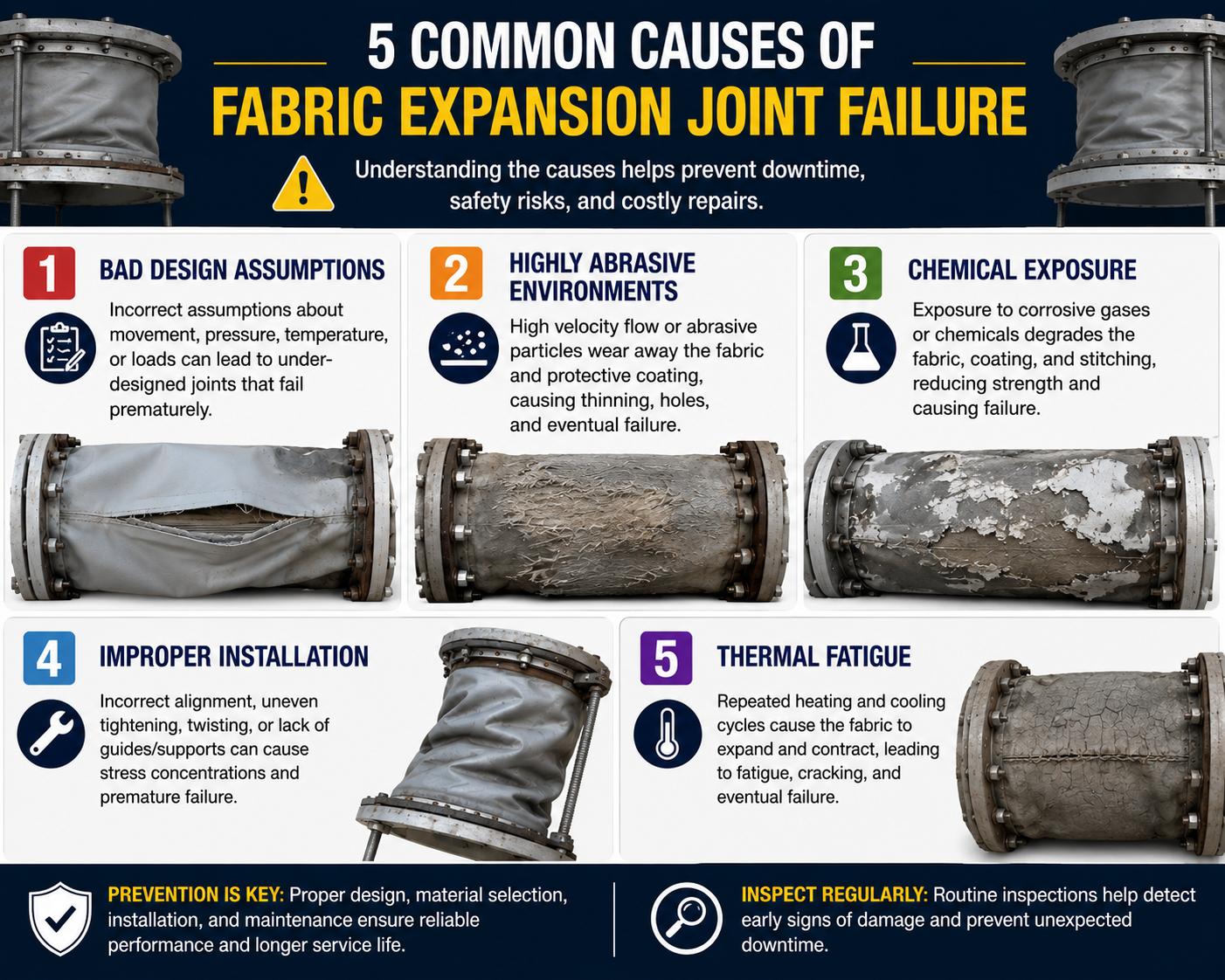
Fabric expansion joints do not just fail unexpectedly. In most cases failure happens because something was missed underestimated or ignored during design installation or operation.
Understanding the root causes is critical not only to prevent downtime but also to extend equipment life improve plant reliability and reduce maintenance costs.
In this article we break down the five most common causes of fabric expansion joint failure observed in real industrial environments.
One of the leading causes of expansion joint failure starts long before installation at the design stage.
Common design mistakes
Why it matters
When movement or operating conditions exceed design limits the fabric joint experiences continuous overstressing leading to premature cracking delamination or rupture.
Industrial systems handling dust ash or particulate matter present a high risk environment for fabric expansion joints.
Key risk factors
What happens
Abrasive particles gradually wear down the fabric layers causing
Fabric expansion joints are often exposed to corrosive gases vapors or chemical splash especially in industries like power generation cement and petrochemical.
Typical issues
Impact on performance
Chemical degradation breaks down the structural integrity of the joint material leading to
Even a well designed expansion joint can fail if installed incorrectly.
Common installation errors
Why it is critical
Improper installation creates localized stress concentration which accelerates wear and leads to
Fabric expansion joints in high temperature systems experience constant heating and cooling cycles.
What causes thermal fatigue
Long term effects
Repeated thermal cycling gradually weakens the internal layers of the fabric causing
Most fabric expansion joint failures are not material problems. They are engineering and application problems.
Choosing the right material is only one part of the solution. The real issue often lies in system design operating conditions and installation practices.